

|
Hi, happy Wednesday,
Have you ever asked ChatGPT or Claude about your business?
Two months ago I asked about mine. I typed my company's name into ChatGPT, Gemini and Perplexity, myself, by hand. Some of them mixed Praxis up with another AI company called Praxis. Others described my old 3D work. And when I asked for the best AI studio for small businesses, none of them named Praxis at all.
I panicked. Then I calmed down and spent two months researching and testing to figure out what actually changes the answer.
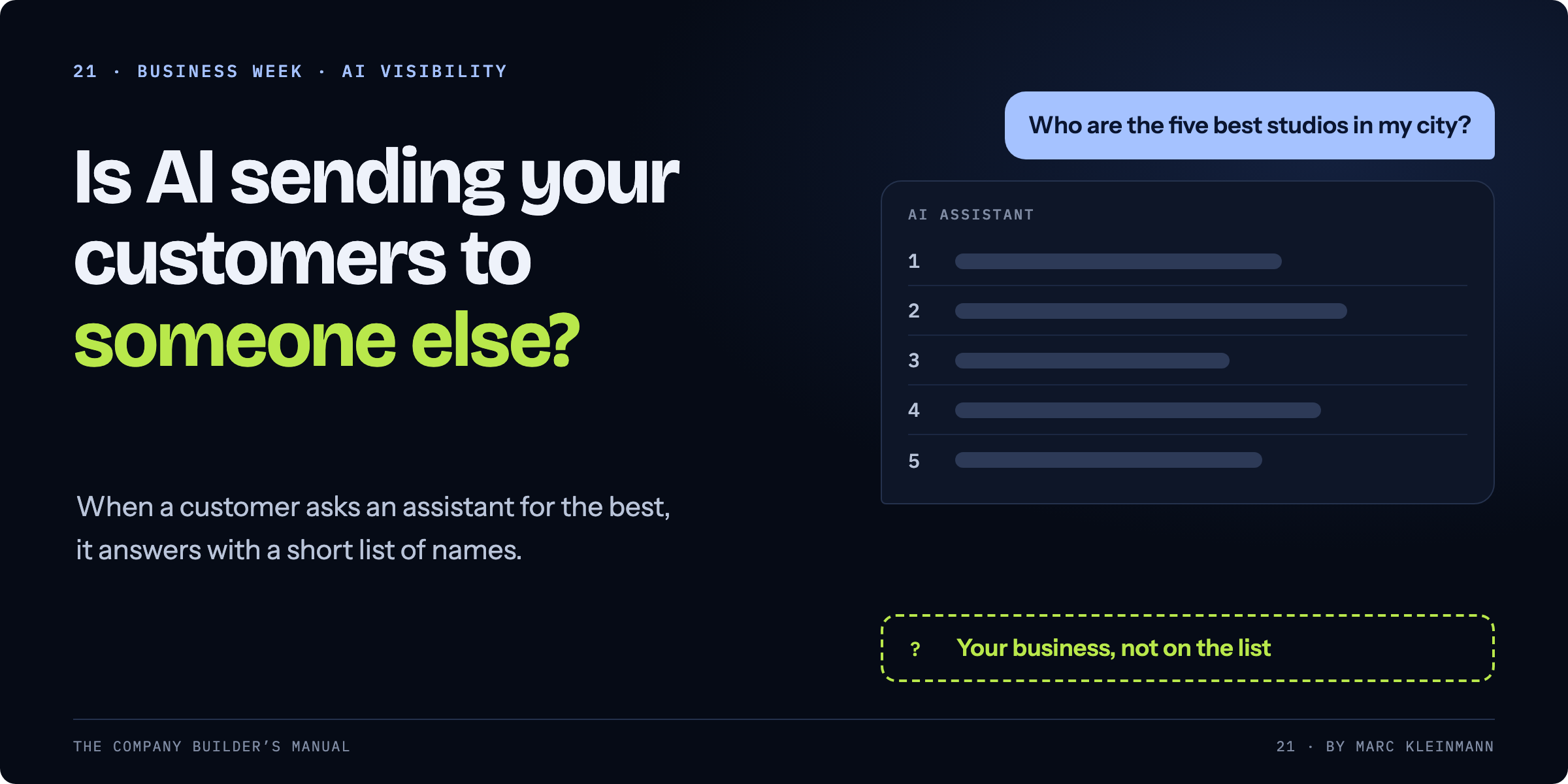
When a customer asks an assistant for the best studio, photographer or agency in your city, the assistant answers with a short list of names. If your name isn't on it, that customer calls someone else, and you never find out they were looking.
This week I'll show you the test I built, what it found on a real client's website before and after a rebuild, and the part a website can't fix on its own.
📌 What the AI assistants can see about your business How I test it, what one studio's new website changed, and the plan for everything outside the website. |
How the test works. I built my own test over those two months. So far I've run it on a client's website and on my own. It works in five steps:
1. It starts with the truth. Before it reads a single answer, I write down the true facts about the business: its name, its address, what it does and who runs it. Every answer gets scored against those facts, not against what sounds right.
2. It reads the website the way an AI tool does. A lot of AI tools don't run the code that builds a modern web page. They only see the words that are there without it. So the test counts those words, page by page, and checks the page titles, the business details filled in behind the scenes for Google, and the list of pages that search engines use to find everything.
3. It checks whether the AI tools are let in at all. AI companies send programs to read websites. The test knocks on the homepage as each of their search programs, from OpenAI, Perplexity, Google, Bing and Apple, and records whether any of them gets turned away.
4. It asks the assistants. Perplexity, and Claude twice: once searching the web, once from memory. For 922 Dragon that was eleven questions each, the same every time. Four ask about the business by name: what it is, and whether it has a kitchen. Seven ask who the best is in its field and city, without ever naming the business.
5. It scores every answer and ranks every problem. Does it know who you are? Does it get your details right? Does it link to your website? Does it recommend you when someone asks for the best? Then every problem gets ranked as serious, fix soon or minor, and I turn that into the action plan.
I'm adding two things to it right now: Grok, including what people say about a business on X, and a scan of Reddit and other forums, because the "who's the best" answers often quote lists and forum threads.
What it can't do yet is ask ChatGPT or Gemini directly. That's why I still ask those two by hand, and why the three questions further down tell you to do the same.
Put together, it shows me what the website hands a search engine, what the AI tools can read, and what the assistants say back when a customer asks.
The 922 Dragon test. Last week I launched a new website for 922 Dragon, a production studio in the Dallas Design District. "Two soundstages and one monster kitchen," in its own words.
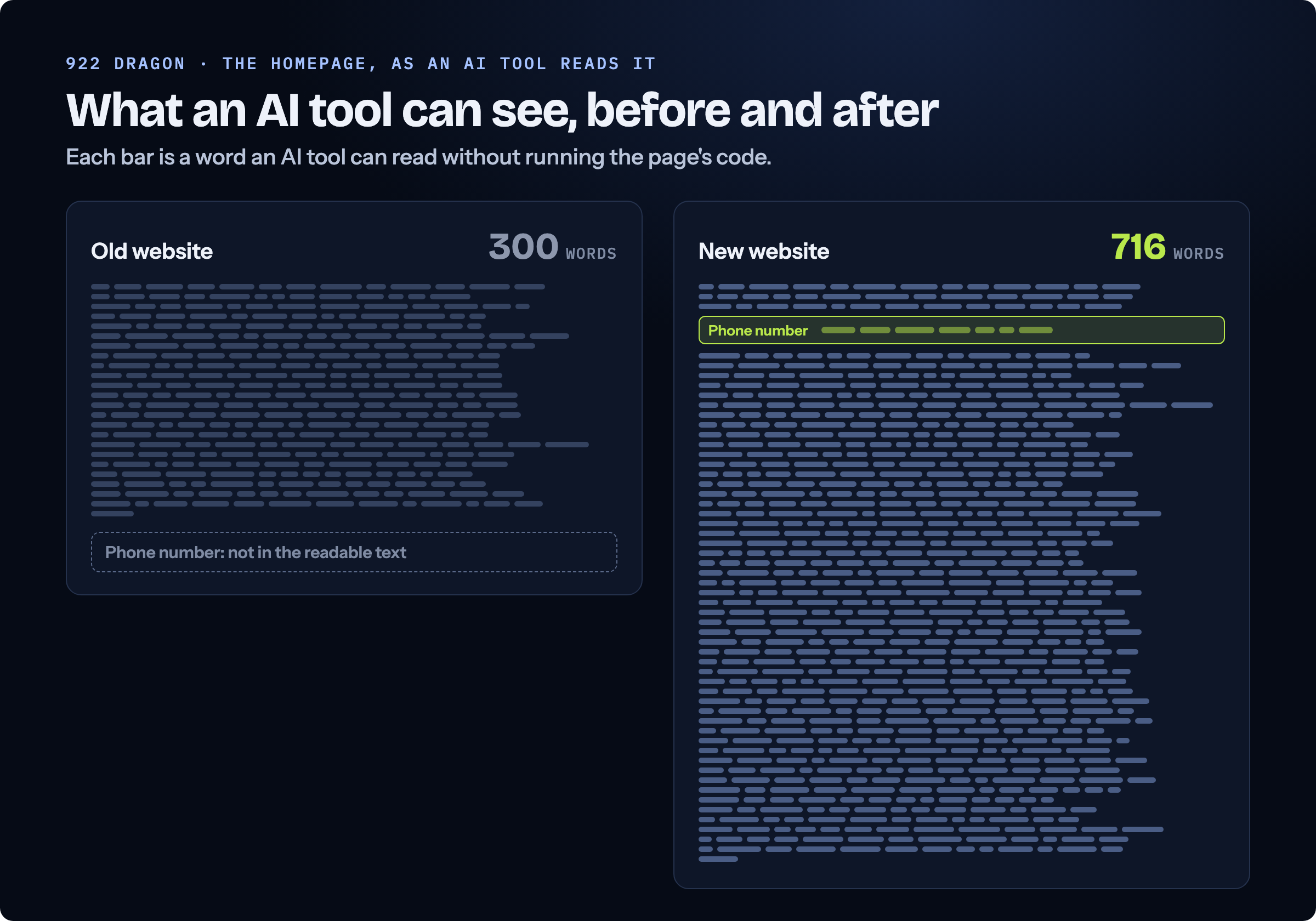
First I took the old website, ran the full test on it and recorded everything it found. It wasn't pretty. Out of 21 "best studio" answers, 0 named 922 Dragon. The test found three serious problems. The homepage had only 300 words an AI tool could read, and the studio's phone number wasn't one of them.
Then I built out the new website with those findings in mind. I added the files that tell search engines what's on the site and when each page last changed.
I filled in the business details behind the scenes, so Google can read the address and the phone number straight from the page. I wrote the phone number out as plain text.
I gave each of the five studio pages a written section of 230 to 320 words. And every old page address now forwards to its new page, so old links still land somewhere useful.
Then I ran the same test again. Here's how they compared:
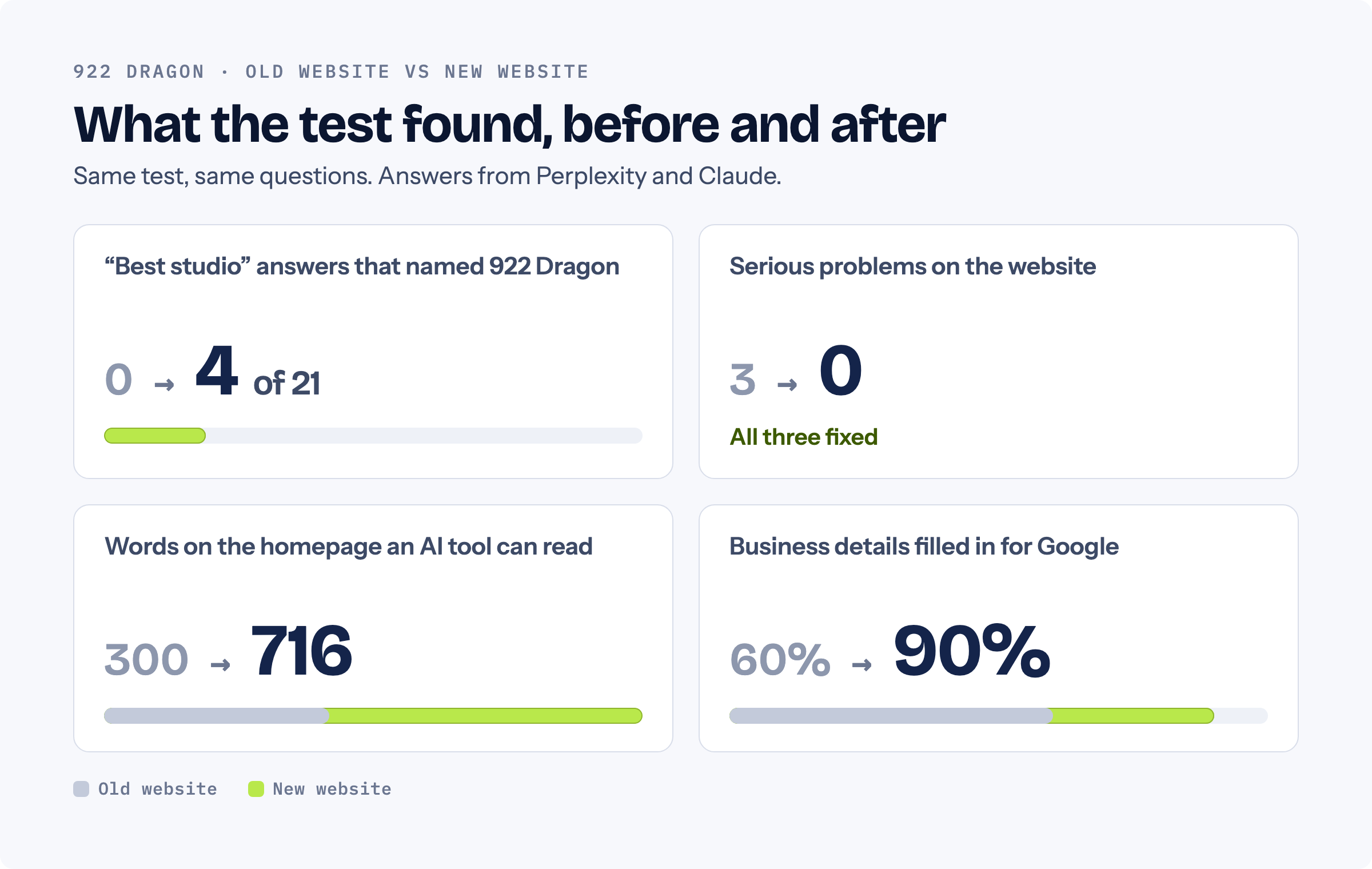
• "Best studio" answers that named 922 Dragon: 0 of 21 before, 4 of 21 after.
• Serious problems: 3 before, 0 after. No real problems left on the site.
• Words on the homepage an AI tool can read: 300 before, 716 after.
• Business details filled in behind the scenes for Google: 60% before, 90% after.
You can see the new site for yourself at 922dragon.com. The final video and photography go up next week.
All four of the answers that named 922 Dragon came from Perplexity, which reads live pages. Claude searching the web still gave answers from the old site, and Claude from memory didn't move at all.
What an assistant knows from memory only changes when it's retrained, which in my estimate takes months. And I ran the old site twice and each later stage once. Perplexity's answers shifted between the two old-site runs, 12 minutes apart, with no change to the site. So I'd call this movement, not proof.
The second plan. The new website is live, and it says the right things. That's everything I could fix from the website. The most damaging problem left is outside it.
One assistant still quotes an old phone number for the studio and links to the old gallery page. Some of that is the assistant rereading an old copy of the site, and that should fade. The phone number most likely comes from other websites that still carry the old details, and no change to 922 Dragon's own site touches those.
So the second plan starts with six things away from the website:
1. Claim the studio's Google Business Profile, then Apple Maps and Bing Places, with the same name, address and phone number as the website.
2. Find the listings that still carry the old details, and correct them or get them taken down.
3. List the studio on the directories production crews use to find stages, including the Dallas and Texas film commission directories.
4. Ask past productions for Google reviews.
5. Get the studio onto the "best studios in Dallas" lists the assistants quote.
6. Every month, ask the main assistants the questions crews ask, and fix whatever any of them gets wrong.
This part overlaps with SEO, because much of what helps you show up in Google helps here too.
But there's no trick that makes an assistant recommend you. You can't edit what it says about you. You can only fix the facts it reads: your own website first, then what other websites say about you.
Try it on your own business. Open ChatGPT, Gemini and Perplexity, and ask each one these three questions, word for word:
1. What is [business name] in [city], and what do they do?
2. Who are the five best [what you do] in [city]?
3. Which websites did you use for that answer?
Then compare three things. Did it describe your business, or someone else with your name? Were you in the five, and if not, which websites did it use for the ones that were? Does your own website say what you do, where you are and your phone number in plain words?
A thin description or a missing phone number points at your own website, and Issue 17 has five fixes for it. A different company with your name, or missing from the five, points at the other websites.
For the website half, run the free AI readiness check. It reads up to 20 public pages of your site, gives you a score out of 100 and lists your three biggest problems.
Why this can't wait. A BrightLocal survey published in March found that 45% of US consumers had used an AI tool for local business recommendations in the past year, up from 6% the year before.
More of your customers ask these assistants every year, and what the assistants find about your business is now part of your reputation. If you haven't looked at it yet, that's the gap I'd close first, because you only see it by asking.
|
If the answers came back wrong and you'd rather I fix it, book an AI visibility call.
Marc